Sustainable Aviation Fuels (SAF)
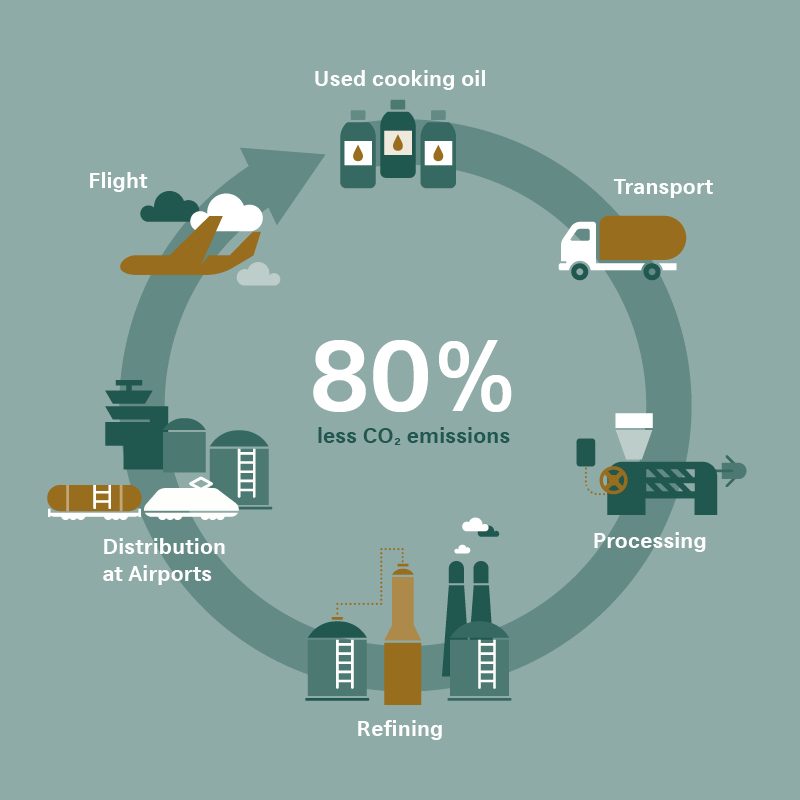
One of the most important keys to reduce the CO2 emissions of the air transport sector is the use of Sustainable Aviation Fuels (SAF). Compared to conventional fossil kerosene, today’s SAF generates at least 80% fewer lifecycle carbon dioxide emissions.
The importance of SAF
Today’s commercial aircraft have a service life of more than 25 years, during which they continue to run on liquid fuels. Even if the much-vaunted electric, hybrid and hydrogen-powered aircraft projects come to fruition as planned, the requisite rollover of present aircraft fleets will extend well beyond 2050. At current development levels, the new power technologies are also only suitable for short- and medium-haul aircraft: long-haul flights will remain reliant on kerosene power for the foreseeable future. And some 80% of all of aviation’s CO2 emissions are generated by flights of more than 1,500 kilometers.
The gradual transition from fossil kerosene to SAF has the potential to significantly reduce lifecycle greenhouse gas emissions from aviation in the long term. At present, however, Sustainable Aviation Fuels are only available in limited volumes and are considerably more expensive than conventional kerosene. This is why SWISS is working actively, through targeted measures and collaborations, to drive the development and expand the availability of SAF together with the Lufthansa Group, its partners and its customers.
What is SAF?
Sustainable Aviation Fuels (SAF) are produced not from fossil materials but from renewable energy sources, such as used cooking oils and fats or agricultural waste. While SAF emits similar CO2 emissions during the combustion as conventional kerosene, its greenhouse gas emissions across the entire lifecycle are at least 80% lower. To enable future CO2 savings, customers can contribute to the use of SAF. SWISS calculates the required amount of SAF based on estimated flight-related CO2 emissions and ensures that this corresponding volume is used on future Lufthansa Group flights. The purchased SAF volumes are not allocated to, nor necessarily used on a passenger’s individual flight.
The raw materials used to create SAF don’t take away from human or animal food and are subject to strict sustainability criteria defined in the EU Renewable Energy Directive (RED II) and the RefuelEU Aviation Regulation which are reviewed by independent auditors.
The SAF used in the Lufthansa Group's offers to customers is purchased in addition to the EU regulatory SAF quota of 2%, the costs of which are already factored into the ticket price via the Environmental Cost Surcharge, and is incorporated into the Lufthansa Group's flight operations within six months after the respective flight. Parts of the eligible SAF used by Lufthansa Group have been co-funded by the EU Emissions Trading System.
There are various production pathways and different feedstocks available as energy sources (e.g.: the biomass-to-liquid process, the HEFA process, the power-to-liquid process, or the sun-to-liquid process). All of these approaches aim to reuse carbon from existing sustainable biomass or gases and convert it into fuel.
SAF currently represents less than 1% of total aviation fuel used worldwide and costs about three to five times more than fossil fuel. SWISS, together with the Lufthansa Group, is involved in numerous projects to ensure that SAF becomes available in larger quantities as quickly as possible.
Biomass-to-liquid
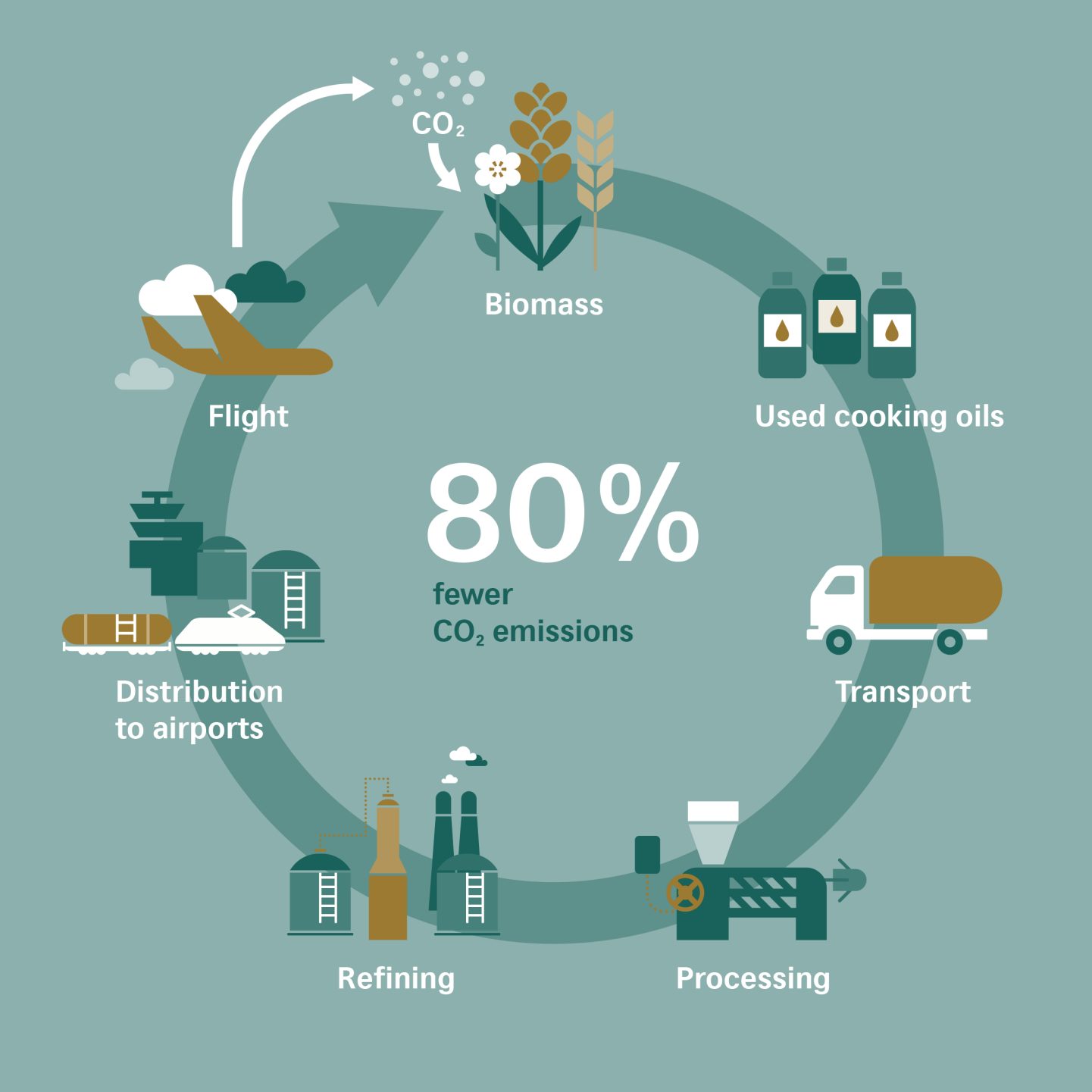
The present generation of Sustainable Aviation Fuels are largely manufactured from biogenic waste such as used cooking oil or fat. When such fuels are combusted, the process only generates as much carbon dioxide as was previously extracted from the atmosphere elsewhere – by plants, for example. So, it is only the production and the transport of these Sustainable Aviation Fuels that create additional CO2 emissions. Compared to fossil fuels, today’s SAF generates at least 80% fewer CO2 emissions. The feedstocks used to produce SAF do not compete with food or feed production and are subject to strict sustainability criteria defined in the EU Renewable Energy Directive (RED II) and the RefuelEU Aviation Regulation, which are verified by independent auditors.
Power-to-liquid and sun-to-liquid
In the future it will be possible to manufacture SAF using power-to-liquid and sun-to-liquid procedures. As the energy (electricity or heat) needed to do so will be generated from renewable sources and the carbon required will be drawn from the atmosphere, a closed carbon cycle can be created in which the fuels manufactured are almost entirely carbon-neutral.
SAF at SWISS
In purely chemical terms, SAF is comparable to conventional kerosene: it is just not based on fossil raw materials. SAF is a so-called drop-in fuel which is added to fossil fuels to produce certificated Jet A-1 kerosene that is delivered to the aircraft via the existing fuel supply channels. SAF can thus be used to power existing aircraft and their engines, and can be handled using existing fueling facilities. SAF also produces fewer fine dust particles when combusted. This results in less cloud formation, which also reduces aviation’s non-CO2 effects and its overall impact on the climate.
Partnership with Synhelion
In view of the limited availability of biofuels, SWISS is supporting the development of solar fuels and has been a strategic partner of Synhelion, a pioneer in the sustainable solar fuel field, since early 2022. The aim of the collaboration is to accelerate the market launch of this forward-looking technology, to bring pilot production projects in Europe to fruition and to scale up global manufacturing capacities. In 2024, Synhelion opened the world's first demonstration plant for the production of solar fuel, supported by SWISS and the Lufthansa Group as partners. In 2025, SWISS became the world’s first airline to receive a symbolic delivery of sun-to-liquid fuel from Synhelion and used this quantity for the first time in regular flight operations.
Partnership with Metafuels
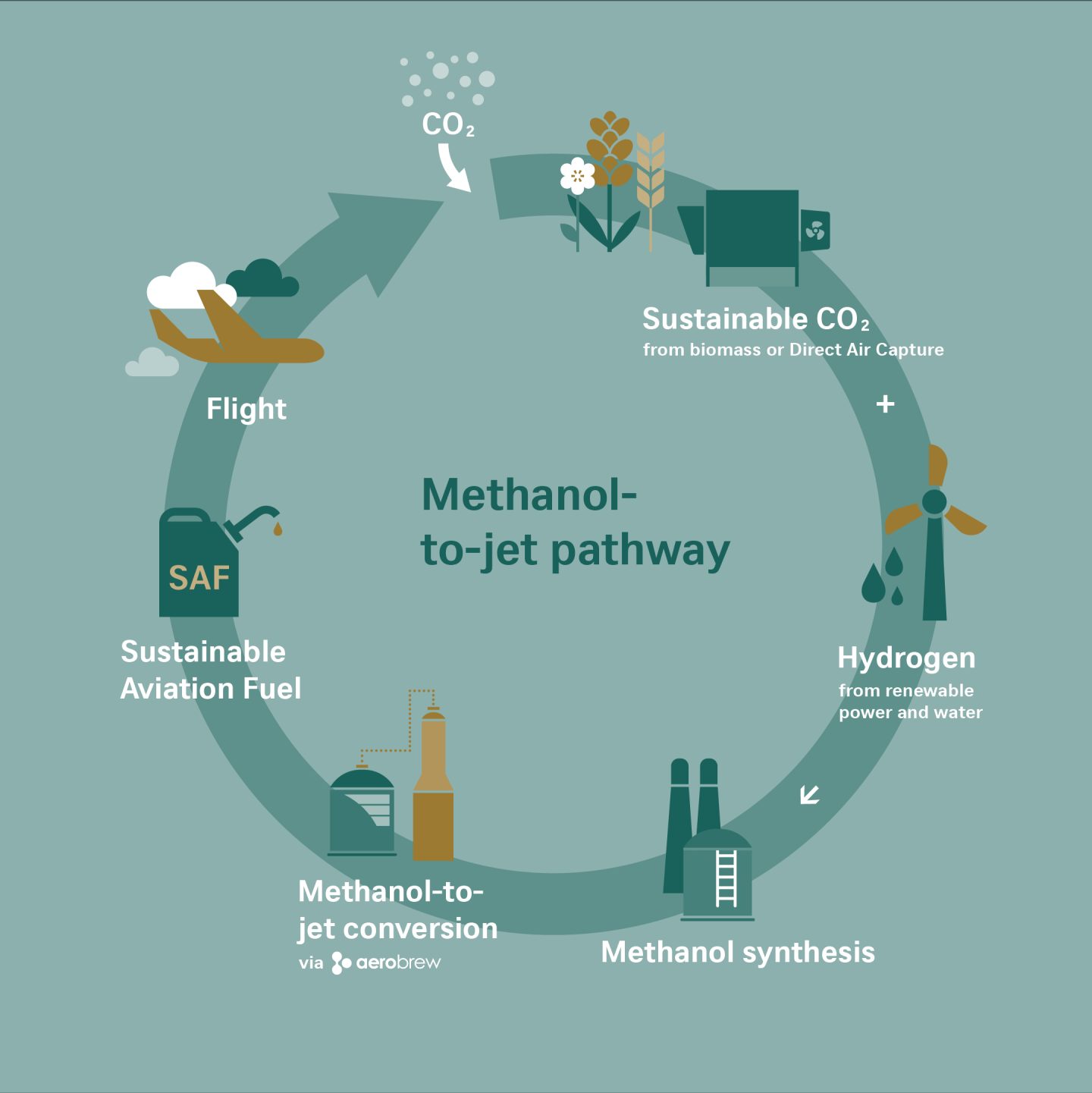
Another step in advancing Sustainable Aviation Fuels is the partnership with the Swiss SAF technology company Metafuels. Metafuels has developed a process that efficiently converts green methanol into Sustainable Aviation Fuel. The technology enables the flexible use of different feedstocks, including both bio-methanol and e-methanol, and is inherently scalable. The synthetic SAF produced can be used within existing infrastructure and today’s aircraft fleets. The agreement with Metafuels strengthens both the commercial development of its technology and the long-standing commitment of SWISS to innovative Swiss solutions for more sustainable aviation.
Through these partnerships, SWISS also actively supports Switzerland as a hub for innovation and research.