
Continuous investment in modern and particularly fuel-efficient aircraft and engine technologies are an important lever for reducing emissions from flight operations. At the same time, SWISS relies on digitalisation as the basis for situation-aware and fuel-optimised decisions in flight operations.

Operational Measures and Fleet Renewal
Efficiency Increase
The consistent implementation of the environmental strategy, based on a range of measures consisting of fleet modernisation, technological innovation and process optimisation in the air and on the ground, has resulted in a significant increase in efficiency and a substantial reduction in noise and CO₂ emissions at SWISS in recent decades. There is a clear decoupling of transport performance (passenger and freight transport) and fuel consumption.
Decoupling of transport performance and fuel consumption
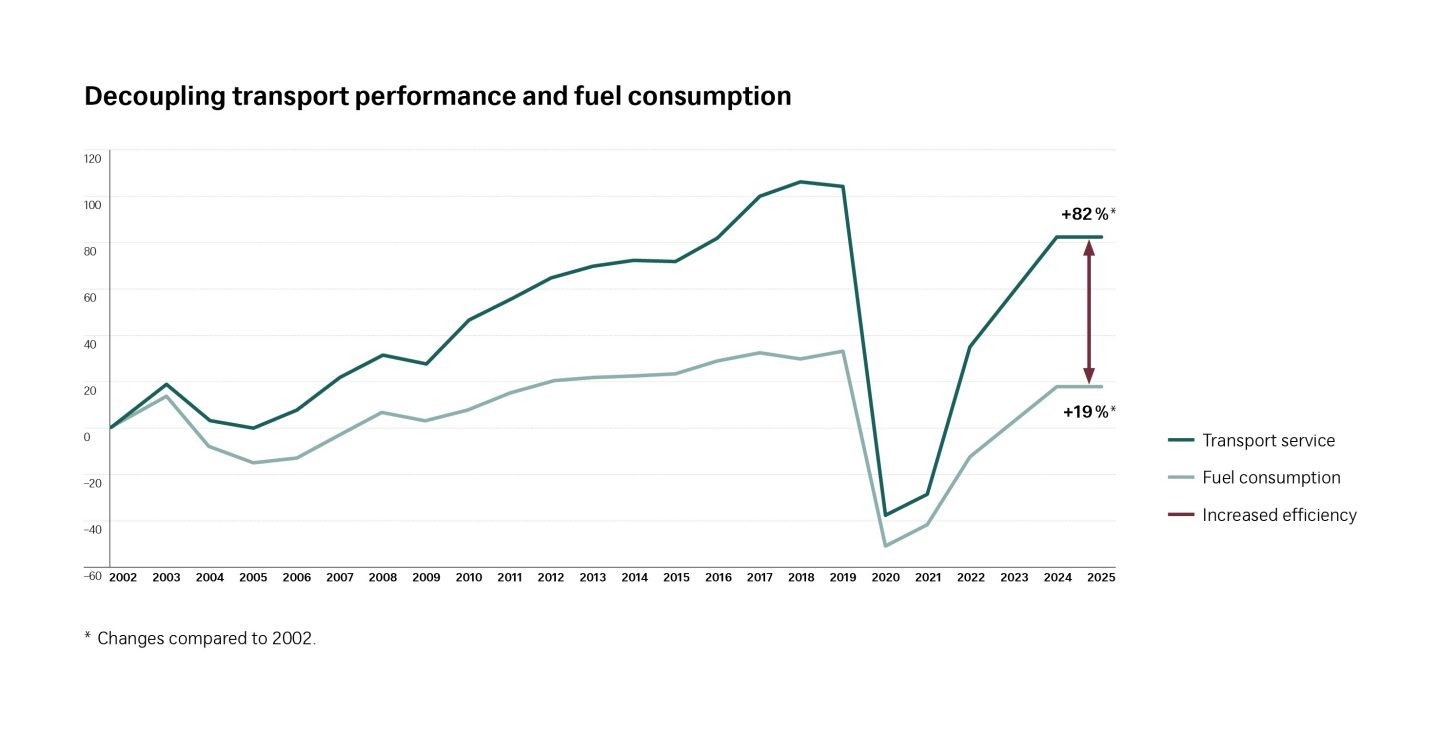
The turquoise line shows the transport performance, the green line shows the fuel consumption. The gap marked in red represents the efficiency increase.
SWISS has been able to reduce its specific fuel consumption – expressed in litres of kerosene used to transport a passenger over a distance of 100 km – by 27% over the same period. The specific fuel consumption for the transport of a passenger over 100 kilometres was 3.21 litres in 2025. This corresponds to 80 grams of CO2 per passenger kilometre. By comparison: the average CO2 emissions of new passenger cars are approx. 130 g/km in Switzerland.
Continuous Fleet Renewal
SWISS operates a modern aircraft fleet and continuously invests in its renewal. SWISS is flying a short-haul model of the newest generation with the Airbus A220. The most modern technologies were used in engines, systems and materials in its development. The fuel savings of approx. 25% compared to its predecessor sets new benchmarks in terms of cost-effectiveness and environmental sustainability.
In the Airbus A320 fleet, the older aircraft are being gradually replaced by the modern A320neo. In addition to numerous small and large improvements on the technical side and a redesign of the cabin, the new engines with geared turbofans help to achieve fuel savings of approx. 20%.
Thanks to its large capacity and range, the Boeing 777-300ER offers the option of transporting the air freight that is important for Switzerland as a business location quickly, reliably and efficiently around the globe, in addition to the 320 passengers. SWISS is the first passenger airline to use the innovative AeroSHARK surface technology on its Boeing 777 aircraft. AeroSHARK is a surface technology jointly developed by Lufthansa Technik and BASF, which consists of ribs (called riblets) measuring approx. 50 micrometres. It specifically imitates the properties of shark skin with its particularly aerodynamic properties, thus optimising aerodynamics at relevant points of the aircraft, which in turn results in reduced fuel consumption and thus CO₂ emissions.
In 2025, SWISS took delivery of its first Airbus A350-900, one of the world’s most advanced and fuel-efficient twin-engine aircraft, marking a significant milestone in the company’s ongoing fleet modernization program.
SWISS has ordered a total of ten Airbus A350 aircraft, which will gradually replace the existing four-engine Airbus A340-300 fleet. These investments underscore SWISS’ commitment to more sustainable flight operations while further enhancing the travel experience for guests across all cabin classes.
Developments in Flight Operations
SWISS relies on digital decision aids to save as much fuel as possible in flight operations. In cooperation with Google Cloud, SWISS has developed a platform for better planning and control of daily flight operations, helping to optimize aircraft deployment and operational efficiency. Routes and cruising altitudes are continuously optimised both before and during the flight using the latest operational and meteorological data. Dispatchers and pilots have access to the latest digital resources for this purpose. After each flight, detailed flight data is also systematically evaluated and used to improve the system further. The impact of operational measures such as switching off engines when taxiing can thus be analyzed and quantified precisely.
SWISS maintains intensive communications with industry and research in various specialized areas. It conducts applied research within the framework of the Single European Sky, and advocates for a less fragmented airspace structure, so that aircraft can fly to their destinations without unnecessary detours, at the optimal flight altitudes and with continuous descent flights. In addition, SWISS continuously develops fuel-saving flight procedures, optimizes fuel planning and reduces aircraft weight to further improve operational efficiency and lower CO2 emissions.